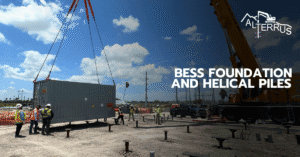
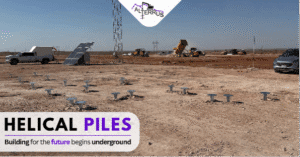
Building a utility-scale battery project in the Permian Basin? Don’t let the region’s notorious soil undermine your multi-million dollar investment. This is your guide to a risk-free foundation.
The race to build the future of the energy grid is happening right here in West Texas. Multi-megawatt Battery Energy Storage System (BESS) projects are rising from the ground, promising to stabilize the grid and unlock the full potential of renewable energy. These are high-tech, high-stakes assets.
But beneath the advanced lithium-ion containers, inverters, and switchgear lies a formidable, ancient challenge: the Permian Basin soil.
This is not the place for a “one-size-fits-all” approach to foundation design. The region’s expansive clays and volatile geology are a direct threat to the long-term performance and profitability of your BESS project. This guide provides the engineering-first approach required to build with certainty in West Texas.
The Core Challenge: Why West Texas Soil is a BESS Project’s Enemy
Before discussing solutions, you must understand the specific geotechnical threat. The dominant soil type in the region is expansive clay.
- When it Rains (Heave): This soil acts like a sponge, swelling with immense force. This upward pressure can lift, crack, and twist a conventional concrete slab, misaligning sensitive equipment and compromising structural integrity.
- When it’s Dry (Settlement): The clay shrinks, creating voids and pulling away from the foundation. This leads to unsupported sections that will inevitably settle, causing stress on conduits, connections, and the BESS containers themselves.
A traditional shallow concrete foundation is in a constant battle with this swell-shrink cycle—a battle it will eventually lose.
Why Traditional Concrete Foundations Introduce Unacceptable Risk
For a fast-moving BESS project, relying on traditional concrete is a strategic error that introduces risk across three key areas:
- Schedule Risk: The typical concrete process (excavation, formwork, pour, cure) can take 4-6 weeks. This “cure time” is a massive bottleneck in your critical path, delaying site energization and your return on investment. The process is also highly susceptible to weather delays.
- Budget Risk: The extensive earthwork, material transport to remote sites, and potential for weather-related overruns make concrete costs unpredictable.
- Performance Risk: A standard slab foundation may meet initial specs, but it offers no long-term protection against the deep-seated soil movement of the Permian Basin, leaving your asset vulnerable to premature failure.
The Engineered Solution: A Turnkey Helical Pile Foundation System
A modern, high-tech asset requires a modern, engineered foundation. For BESS projects in West Texas, a turnkey helical pile system is the superior solution, designed to mitigate all three risk factors.
1. Bypassing the Problem Soil Entirely
Helical piles (or screw piles) are not a surface solution. They are steel deep-foundation elements that are hydraulically screwed through the volatile expansive clays. They are anchored deep into a stable, load-bearing stratum (like caliche or bedrock) that is completely unaffected by surface moisture changes. This doesn’t just manage the risk of soil movement; it eliminates it.
2. Compressing Your Schedule from Weeks to Days
The installation of a complete helical pile foundation for a BESS facility is measured in days, not weeks.
- No Cure Time: The moment a pile is installed to the specified torque, it is ready for 100% of its design load. BESS containers can be set the same day.
- All-Weather Installation: The process can continue in rain or cold that would shut down a concrete pour.
- Minimal Site Disruption: Installation requires smaller equipment and creates no excavated spoils, simplifying site logistics.
3. Providing Quantifiable, Engineered Certainty
With concrete, capacity is an assumption until a 28-day strength test. With helical piles, capacity is a verified fact. During installation, the torque required to advance the pile is measured in real-time. This torque data directly correlates to the pile’s load-bearing capacity, providing instant, documented proof of performance for every single pile under every BESS container, transformer, and inverter.
Your Turnkey BESS Foundation Partner in West Texas
Alterrus provides a complete, turn-key foundation solution specifically for BESS developers in the Permian Basin. We understand the local geology and the urgency of your project. Our process covers the entire foundation scope:
- Geotechnical Plan Review & Engineering Design
- Foundations for BESS Containers, PCS Skids, and Inverters
- Transformer Pads & Switchgear Foundations
- Fire Suppression & Auxiliary Equipment Support
Your BESS project is too important to build on a foundation of risk. Start with a foundation engineered for the challenges of West Texas.
Ready to design a faster, more reliable foundation for your BESS project?